
Crypto Token Development Company
Deploying a token takes an afternoon. Designing one that holds value, survives an audit and doesn't collapse the moment early holders sell — that takes real work. We handle the tokenomics, the contracts and the launch mechanics that decide which of those you end up with.
Get free consultation
Token Development Services We Offer
From a straightforward utility token to a full multi-chain ecosystem with staking, governance and vesting — we cover the economics, the contracts and the launch infrastructure, then hand the whole thing over to you.
Custom Token Development
ERC-20, BEP-20, SPL and TRC-20 tokens built around your actual use case — supply logic, minting rules, burn mechanics and transfer restrictions written to match how your project works.
Tokenomics Design & Modelling
Supply schedules, allocation splits, emission curves and sink mechanics modelled before launch. Most tokens fail here, not in the code — so this is where we spend the most time.
Vesting & Token Locking
On-chain vesting for team, investor and treasury allocations with cliffs and linear release — visible to anyone, so holders can verify your unlock schedule instead of trusting a spreadsheet.
Staking & Rewards Contracts
Single-asset and LP staking, reward pools and yield distribution — engineered so rewards remain solvent under real participation rates, not just the optimistic model.
Governance & DAO Tokens
Voting weights, proposal thresholds, timelocks and delegation built so governance is genuinely usable — and resistant to a single whale deciding every outcome.
Token Launch & Listing Support
Presale contracts, liquidity provisioning, LP locking and DEX or CEX listing preparation, with the documentation exchanges ask for ready before you apply.
Multi-Chain & Bridged Tokens
Deploy the same token across Ethereum, BNB Chain, Polygon, Solana and Base, with bridge integration that keeps supply accounting correct on every network.
Token Audit & Security Review
Independent review of supply logic, ownership functions and access control — including the honeypot patterns and hidden mint functions that investors now check for by default.
Token Types We Build
The standard you pick determines what your token can legally do, where it can list and how holders will expect it to behave. Getting this wrong is expensive to undo — so we settle it before anything is deployed.
What Your Token Can Do
Controlled Supply Mechanics
Fixed caps, scheduled minting, burn-on-transaction or elastic supply — whichever model your economy needs, enforced by the contract rather than a promise.
Automated Fee Distribution
Transaction fees split automatically between treasury, liquidity, staking rewards and burns, with every share visible on-chain.
Transparent Vesting
Team and investor allocations locked in contracts anyone can inspect — the single fastest way to answer the question every serious buyer asks.
Staking & Passive Yield
Holders lock tokens for rewards, reducing circulating supply and giving people a reason to stay through the quiet periods.
On-Chain Governance
Token-weighted voting on proposals and treasury spending, with timelocks so no decision executes before the community can react.
Wallet & Exchange Ready
Standards-compliant from the start, so your token works in MetaMask, Trust Wallet and every major DEX without special handling.
Blockchains We Launch Tokens On
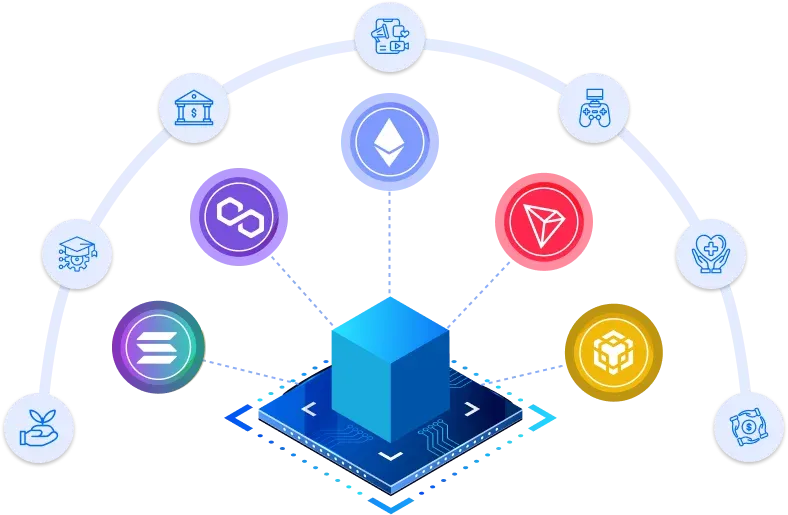
Fees, listing options and the audience already holding funds differ sharply between chains. We'll recommend based on where your buyers actually are and what each transaction can reasonably cost — not on which ecosystem is currently loudest.
Discuss your tokenOur Token Development Process
Token supply, ownership and distribution become permanent the moment you deploy. So the economics get settled and stress-tested first, the contract is audited second, and mainnet comes last — never the other way round.
Discovery & Token Utility
We establish what the token is actually for, who needs to hold it and why demand would exist beyond speculation — before any numbers get chosen.
Tokenomics Modelling
Supply, allocations, emissions and unlock schedules modelled and stress-tested against sell pressure so the launch survives its first unlock event.
Contract Development
Token, vesting, staking and governance contracts written to standard, gas-optimised, and deployed to a testnet you can interact with early.
Audit & Verification
Internal review plus independent third-party audit, with findings fixed and re-tested — then source verified publicly on the explorer.
Launch & Listing
Mainnet deployment, liquidity provisioning with locked LP, listing preparation, and ongoing support as your ecosystem grows.
Why Teams Choose ITSPECTRUM
For Token Development
Plenty of firms will deploy a token contract for you cheaply. Far fewer will tell you when your tokenomics don't work, or refuse to ship something they wouldn't hold themselves.
Economics Before Code
We model your token economy and show you where it breaks before writing a contract. If the numbers don't work, you'll hear it early — while changing them is still free.
Audit-Ready By Default
Every contract is written to pass external review, with no hidden mint functions or owner privileges that investors would flag the moment they read the code.
Transparent By Construction
Verified source, locked liquidity and on-chain vesting mean your holders can confirm your claims themselves rather than taking your word for it.
Built For What Comes After Launch
Launch day is the easy part. Staking, governance, cross-chain expansion and treasury management are what keep a token relevant a year later — so we design for them from the beginning rather than bolting them on when momentum has already gone.
No Vendor Lock-In
Contracts, tests, deployment scripts and documentation are yours on delivery. Take them to any other team without needing our cooperation.
Straight Answers
If a feature adds risk without adding value, we'll say so. You get an engineering opinion, not agreement with whatever you asked for.
Ready To Launch Your Token?
Bring us a whitepaper, a rough allocation table or just an idea — whichever stage you're at. You'll get an honest read on the economics, plus a clear scope, timeline and cost.
Start your token projectFrequently Asked Questions
The questions clients ask us most before launching a token.